Yes, for planned procedures. We use that time for health monitoring, diet counselling, and walking the family through what to expect, so surgery day isn't the first time you're hearing any of it.



Surgical Home Healthcare
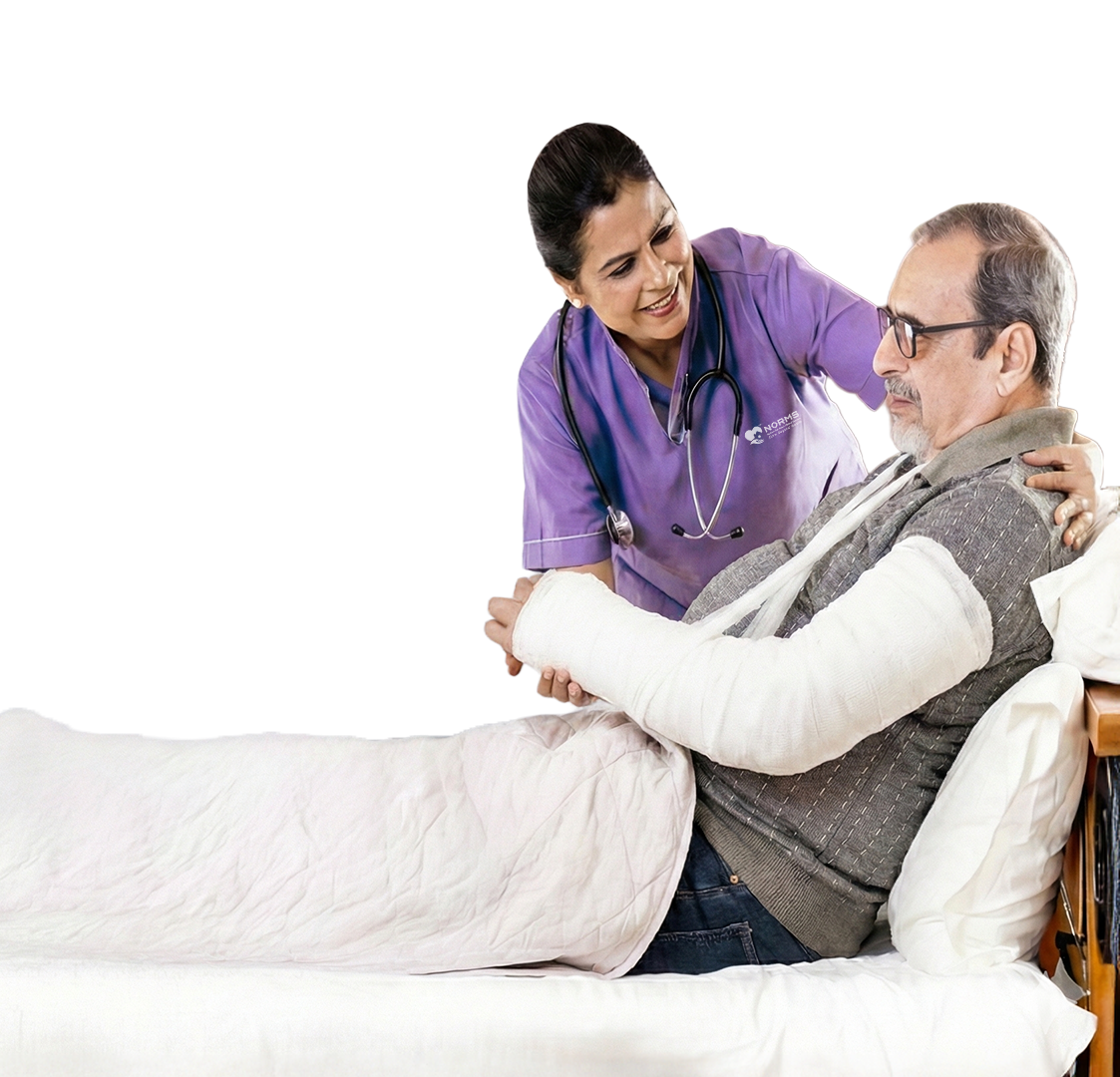
Surgery is only part of the journey.
Surgery is only part of the journey. What happens next, at home, is what actually determines how well and how quickly someone recovers. Whether the surgery was planned months in advance or came on suddenly, the questions families ask us are the same: is my family member ready for this, and who's looking after them once they're home? We stay with the case for both.
For planned surgeries, like a knee replacement, a spinal procedure, or cataract surgery, care can start before the operation. That means preparing the body and the family, not just scheduling the date.
For emergencies, our involvement typically begins once the acute crisis has passed and the patient is stable, and the focus shifts entirely to recovery.
Leaving the hospital doesn't mean leaving care behind. It means recovery, on the patient's terms, in their own space, with support that adjusts as things progress.
Get in touch with us
How We Car For You

Health Monitoring
Tracking vitals closely, before and after surgery.

Diet Counselling
Guiding nutrition to support healing and recovery.

Specialist Coordination
Connecting the right specialists to your case.

Physiotherapy & Rehabilitation
Rebuilding strength and movement, step by step.
Wound Care
Managing healing closely, to prevent complications.
Specialist Nursing
Skilled nursing for complex post-surgical needs.

Nursing Care – 12/24 Hours
Scaling from a few hours to round-the-clock care.

Dedicated Attendants
Consistent, familiar support through recovery.
Care can start before surgery, to prepare the body and the family, and continue after, scaling from a few hours of support to full nursing care as recovery actually needs it.
Testimonials
It's not until critical times that one realises the importance of intensive "home care." It was a godsend to have the NORMS team take care of every single detail, round the clock. I am deeply thankful to them.
The extraordinary quality and the comprehensiveness of care provided by N.O.R.M.S team has to be seen to be believed. We stand truly humbled by the humanity of the N.O.R.M.S team
Talk to us
+91 75501 01018
A Few Things Families Ask Us
What about emergency surgeries, is there support for those too?
Yes. Once the patient is stable, our team steps in to manage recovery, wound care, nursing support, and physiotherapy, so the hardest part of getting back on their feet doesn't happen alone.
How is this different from just hiring a nurse after surgery?
A nurse handles the day-to-day. This adds coordinated specialist input and a plan that scales, from a few hours of support to full 12 or 24-hour nursing and a dedicated attendant, as the case actually requires.
How do you decide how much care is needed, and does it change over time?
It's based on the surgery and how the patient is healing, not a fixed package. Some cases need close nursing early and taper down; others, especially after major surgery, need long-term rehabilitation. We reassess as recovery moves, so the support scales with it, not the other way around.




